Legal Web Design
Law Firm Website Compliance in Washington State
A working guide to WSBA Rules of Professional Conduct for attorney websites — with real examples from immigration and tax law firms we have built in the Seattle-Bellevue corridor.
Overview
Most law firm websites in Washington State contain at least one compliance issue. Not because attorneys are careless — but because the designers who built the sites never read the Washington Rules of Professional Conduct. The result is a website that looks professional but exposes the firm to bar complaints, disciplinary action, or at minimum an uncomfortable conversation with the ethics board.
Washington retains the pre-2018 ABA rule structure with separate, detailed rules for advertising (RPC 7.1), solicitation (RPC 7.3), specialization claims (RPC 7.4), and firm names (RPC 7.5). This is more granular than many states that adopted the ABA's simplified 2018 amendments. A designer who builds law firm websites in Washington needs to understand each rule and how it maps to specific design decisions — from the words on a practice area page to the behavior of a contact form.
This article walks through every rule that applies to attorney websites, explains what each one requires in practical terms, and shows how we have applied them across real projects for immigration law, tax law, and employment-based visa practices in the Seattle-Bellevue market. If you are an attorney evaluating your current website or hiring a designer to build a new one, this is the compliance checklist your project needs.
RPC 7.1 is the foundation of every other advertising rule. A lawyer shall not make a false or misleading communication about the lawyer or the lawyer's services. A communication is false or misleading if it contains a material misrepresentation, omits a fact necessary to make a statement not misleading, creates unjustified expectations about results, or compares services with other lawyers unless the comparison is factually substantiated.
On a website, this rule governs everything from hero section headlines to case result pages. Claims like “best immigration lawyer in Seattle” or “top-rated tax attorney” violate 7.1 unless they reference a verified, legitimate third-party ranking. Superlative language is the most common violation we see on attorney websites — and the easiest to fix.
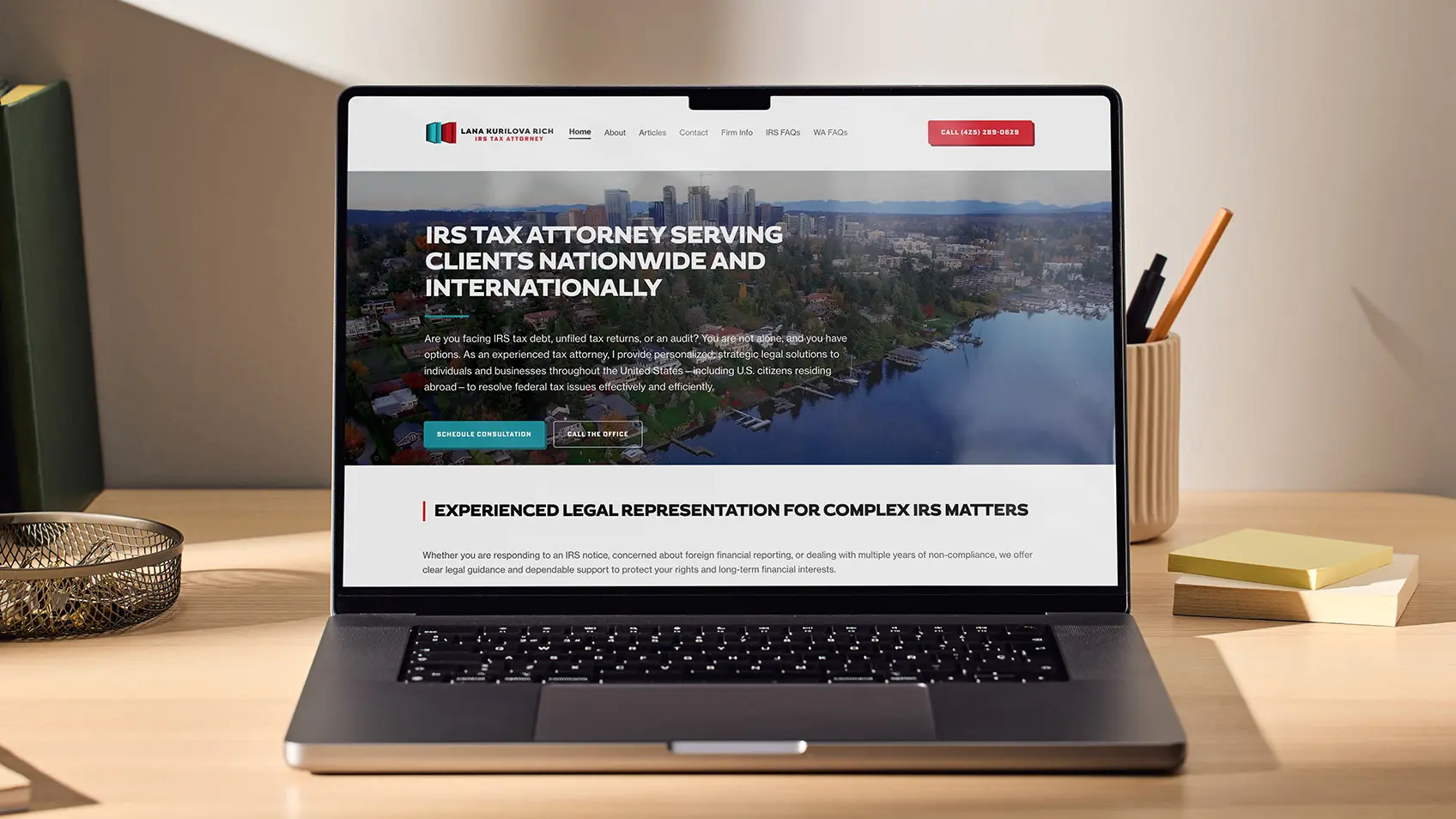
Case results and success statistics require particular care. A tax law firm that lists specific settlement amounts without disclaimers creates unjustified expectations. When we built mytaxdebtattorney.com for Lana Kurilova Rich, PLLC, the disclaimer page explicitly states: “The information you obtain at this site is not, nor is it intended to be, legal advice. You should consult an attorney for advice regarding your individual situation.” That language protects against 7.1 claims by ensuring visitors understand the site is informational, not advisory.
Design takeaway: Every claim on a law firm website should be verifiable. If it cannot be substantiated, rewrite it. Every results page needs a disclaimer. Every testimonial needs context.
RPC 7.1
RPC 7.2
RPC 7.2 permits lawyers to advertise through electronic communication — including websites — but requires that every communication include the name and contact information of at least one lawyer or law firm responsible for its content. This means every page of a law firm website should clearly identify the responsible attorney or firm, not just the homepage.
Washington does not require pre-filing or pre-approval of website content with the WSBA — unlike Florida, Texas, and several other states. This gives Washington attorneys more flexibility, but it also means compliance is entirely self-policed. There is no review process to catch violations before they go live.
On crescent-law.com, every page identifies Crescent Law, PLLC and attorney Matty Luna in the site header and footer. The footer also lists office locations — the Columbia Tower in Seattle and the Tukwila office — with direct phone numbers. This satisfies 7.2's identification requirement across every page of the site.
RPC 7.2 also prohibits paying for recommendations. Pay-per-lead arrangements with legal directories can violate this rule if they constitute paying someone to recommend the lawyer rather than simply advertising. The distinction matters for firms that invest in platforms like Avvo, FindLaw, or Justia — the arrangement must be structured as advertising, not referral compensation.
RPC 7.3 restricts live person-to-person solicitation when the primary motive is the lawyer's financial gain. Written, recorded, or electronic communications — including website contact forms, email intake, and chatbots — are not considered live contact and fall under the advertising rules instead.
The gray area is live chat. If a law firm website includes a live chat feature where an attorney proactively engages a visitor who has not initiated contact, it could be interpreted as live solicitation under 7.3. Chatbots that respond to visitor-initiated queries are generally safe. Pop-up widgets that aggressively push “talk to an attorney now” before the visitor has taken any action are more problematic.
For the immigration law sites we built — seattleh1bvisa.com and bellevueworkvisas.com — we implemented consultation request forms with explicit language: “Submitting a consultation request does not create an attorney-client relationship.” The contact mechanism is visitor-initiated and clearly delineated from representation. No live chat, no aggressive pop-ups.
Design takeaway: Contact forms are safe. Email intake is safe. Chatbots that respond to visitor questions are safe. Live attorney outreach to passive visitors is risky. Design the intake flow so the visitor always initiates.
RPC 7.3
RPC 7.4
This is the rule that trips up more law firm websites than any other. RPC 7.4 states that a lawyer shall not state or imply that they are a specialist in a particular field unless they have been certified by an organization approved by the appropriate state authority or accredited by the ABA.
Washington does not have a state-run specialization certification program. Very few Washington attorneys hold certifications that would permit the use of “specialist” — typically limited to patent attorneys (authorized by the USPTO) and those with NBLSC credentials. For everyone else, the word “specialist” is a compliance violation waiting to happen.
The same caution applies to “expert.” Courts and bar associations generally treat “expert” as carrying the same implication as “specialist.” Both words suggest a formal credential that most attorneys do not hold.
Safe alternatives we use across every law firm site: “focuses on,” “concentrating in,” “dedicated to,” “experienced in,” and “practice areas include.” On crescent-law.com, the firm describes its work as “personalized legal guidance for U.S. immigration cases” and “comprehensive immigration legal services” — never “immigration law specialists.” On mytaxdebtattorney.com, Lana Kurilova Rich describes “more than 20 years of focused experience” in federal tax matters — the word “focused” instead of “specialized.”
Design takeaway: Search every page of the site for “specialist,” “specialize,” and “expert.” Replace them. This is a find-and-replace compliance fix that takes five minutes and prevents a bar complaint.
RPC 7.5 governs firm names, letterheads, and professional designations — including domain names. A trade name may be used if it is not misleading and does not imply a connection with a government agency or public legal services organization.
Keyword-rich domain names are common in legal marketing, and they are permissible under 7.5 as long as the site content is truthful. Domains like seattleh1bvisa.com and bellevueworkvisas.com are descriptive trade names — they tell the visitor what the practice handles and where it is located. Both sites clearly identify the actual legal entity (Crescent Law, PLLC) and the responsible attorney (Matty Luna) on every page, which satisfies 7.5's requirement that the firm name not misrepresent the practice structure.
The compliance risk with trade name domains is implying a partnership or group practice when none exists. A solo practitioner using a domain like “Seattle Immigration Law Group” could mislead visitors into thinking the firm has multiple attorneys. The site content must clearly represent the actual practice structure — solo, partnership, or PLLC — to avoid this issue.
Geographic terms in domain names also carry a truthfulness requirement. “Bellevue” in bellevueworkvisas.com implies a Bellevue presence — which is accurate, as the firm maintains offices in the Seattle-Bellevue corridor. A firm using a city name with no actual office or presence there would risk a 7.1 violation for misleading geographic claims.
Design takeaway: Descriptive domains are powerful for SEO and permissible under 7.5. But the site must clearly identify the actual firm, the responsible attorney, bar admissions, and office locations. The domain tells visitors what you do — the site content tells them who you are.
RPC 7.5
Compliance Checklist
Disclaimers Every Law Firm Website Needs
No Attorney-Client Relationship
“Use of this website or contact through this site does not create an attorney-client relationship.” This should appear near every contact form, on a dedicated disclaimer page, and ideally in the site footer. On seattleh1bvisa.com, this disclaimer appears both on the contact form and in a dedicated disclaimer section.
No Guarantee of Results
“Prior results do not guarantee a similar outcome. Every case is unique.” Required near any case results, success statistics, or testimonials. Both seattleh1bvisa.com and bellevueworkvisas.com include the statement “Attorney Advertising. Prior results do not guarantee a similar outcome” in the site footer.
Confidential Information Warning
“Please do not send confidential information to us until an attorney-client relationship has been established.” This appears on the mytaxdebtattorney.com disclaimer page — critical for tax law firms where clients may instinctively share sensitive financial information through a contact form before any engagement is formalized.
Jurisdictional Disclosure
“Attorney licensed in Washington State.” Important for firms that serve clients in multiple states or handle federal matters. On crescent-law.com, the credentials section lists Washington State Bar Association membership explicitly — and since immigration law is federal practice, the site also notes nationwide availability through video consultations.
Attorney Advertising Notice
While Washington does not require the words “THIS IS AN ADVERTISEMENT,” including an “Attorney Advertising” notice protects firms that serve clients across state lines. States like Kentucky, Tennessee, and Nevada have stricter labeling requirements — a single footer line covers the firm regardless of where the visitor is located.
Testimonials
Washington is more permissive than many states when it comes to testimonials on law firm websites. Testimonials are allowed under RPC 7.1 as long as they are not false or misleading and do not create unjustified expectations about results. States like Florida prohibit client testimonials entirely on attorney websites — Washington does not.
The practical risk is a testimonial that implies a guaranteed outcome. A Google review that says “she got my visa approved in two weeks” is a factual statement about one case — but without context, it could create unjustified expectations for every prospective client who reads it. The solution is not to remove the testimonial but to frame it properly.
On crescent-law.com, client testimonials are displayed alongside the firm's results disclaimer. This approach lets the firm showcase genuine client experiences — which build trust and convert visitors — without creating the compliance exposure that uncontextualized testimonials carry.
Design takeaway: Display testimonials in a section that includes a visible disclaimer. Do not place testimonials next to specific case outcomes without additional context. And never fabricate, edit for substance, or pay for testimonials — all of which violate 7.1.
Many law firms in competitive markets operate multiple websites — a primary firm site plus practice-specific or geo-specific landing sites. This is a legitimate and effective strategy for SEO, but it introduces additional compliance considerations under both RPC 7.2 and 7.5.
We built this exact structure for Crescent Law, PLLC: crescent-law.com serves as the primary firm site covering the full scope of immigration services — from asylum and VAWA petitions to family visas and deportation defense. Then seattleh1bvisa.com and bellevueworkvisas.com target the employment-based visa market in the Seattle-Bellevue tech corridor — H-1B, TN, O-1, L-1, and PERM labor certification.
Each site must independently satisfy all compliance requirements. The practice-specific sites cannot rely on the primary firm site for disclaimers or attorney identification — every site needs its own complete set. All three sites identify Crescent Law, PLLC as the legal entity, Matty Luna as the responsible attorney, and list bar admissions (WSBA, KCBA, AILA) on every page.
The advantage of this approach is significant. A potential client searching “H-1B visa lawyer Seattle” is more likely to find and trust a site built entirely around that topic than a general firm site with a buried practice area page. The compliance cost is simply ensuring each site stands on its own — which any designer building for law firms should already be doing.
Strategy
Common Mistakes
What Most Web Designers Get Wrong
Writing “Specialist” in Practice Area Headers
The most common and easily avoidable violation. Designers write what sounds impressive without understanding the legal distinction. Every practice area heading should use “focuses on” or “practice areas include” — never “specializes in.”
Omitting Disclaimers from Contact Forms
A contact form without a no-attorney-client-relationship notice and a confidentiality warning is an ethics complaint waiting to happen. These should be visible — not buried in a terms of service link that no one reads.
Using Superlative Headlines for SEO
“Best lawyer in Seattle” or “#1 immigration attorney” might sound good for search rankings, but they violate RPC 7.1 unless backed by a verifiable, legitimate third-party ranking. Effective legal SEO does not require superlative claims — it requires strategic content, proper schema markup, and topical authority.
Placing Uncontextualized Testimonials
Embedding Google reviews or client quotes without results disclaimers. The testimonial itself may be truthful, but without context and a disclaimer, it can create unjustified expectations under 7.1.
Aggressive Chat Widgets and Pop-ups
Live chat where an attorney proactively engages visitors before they have taken any action could be interpreted as solicitation under RPC 7.3. Chatbots that respond to visitor-initiated queries are safe. The design should ensure the visitor always initiates the conversation.
Get Started
Start a Project
Ready to strengthen your digital presence? Let's discuss how I can help.